Can an Old, Dark, or Blurry Pet Photo Become Memorial Art?

Sometimes the only photograph that truly matters is also the most difficult one.
It may be faded, dark, soft, scratched, cropped, compressed, or taken years before anyone imagined turning it into memorial art.
That does not automatically make it unusable.
WTx3D reviews each memorial photograph based on the finished Framed 3D Layered Art it may be able to produce. The studio may simplify the background, improve brightness and contrast, adjust the crop, strengthen subject separation, upscale the file when useful, and sharpen genuine detail that remains.
But cleanup is not the same as inventing missing information.
No process can reliably recreate exact eyes, markings, whiskers, fur, feathers, scales, or body details that the source never captured or no longer contains.
The goal is the strongest honest result the photograph allows.
Explore Pet Memorial Custom Photo Art.
Old is not the same as unusable
An older photograph may still preserve what matters most:
- Recognizable face or profile
- Eye placement
- Ear or head shape
- Coat, feather, scale, or marking pattern
- Familiar pose
- Relationship with a person or another companion
- A meaningful life stage
- Favorite place, activity, or routine
The important question is not simply, “Is this a good photograph?”
It is:
Does the source contain enough real identity to become strong layered memorial art?
That answer depends on the type and severity of the problem.

Different problems need different decisions
| Source problem | What may help | Main limitation |
|---|---|---|
| Faded or low contrast | Contrast, white and dark levels, crop, background simplification | Original color may not be recoverable exactly |
| Dark exposure | Brightness, tonal separation, background treatment | Featureless black areas contain little usable detail |
| Mild softness | Careful sharpening and stronger edges | Severe motion blur may replace real facial information |
| Scratches, creases, or spots | Cleanup where damage crosses simple areas | Damage through an eye, marking, or face can remove identity |
| Tiny, cropped, or obstructed subject | Upscaling, tighter composition, alternate image role | Missing anatomy or blocked features cannot be guaranteed |
| Screenshot or compressed copy | Review and limited enhancement | Repeated compression may permanently remove fine detail |
A photograph may have more than one problem. A dark screenshot of a black pet with a tiny face is far more difficult than a faded print with a clear, recognizable head shape.
Look for the strongest source before editing the weakest one
Before depending on a small screenshot or damaged print, search for a better version.
Useful places include:
- Original camera or phone file
- Family cloud storage
- Older computer, drive, or phone
- Duplicate print or album copy
- Relative’s copy
- Shelter or rescue file
- Breeder, trainer, or veterinary photograph
- Another frame from the same moment
- Clearer image from the same life stage
A better source often improves the final result more than aggressive editing of a weaker copy.
When another photographer or organization created the image, the customer must confirm permission to reproduce it.
When the only source is a physical print
A physical print must first become a clean digital file.
A careful scan is usually the best starting point. A careful phone or camera photograph may also work.
Capture the print correctly
- Keep it flat
- Photograph it straight on
- Include the complete image
- Use even light
- Avoid glare and window reflections
- Avoid shadows from the phone or hands
- Keep the camera steady
- Do not add heavy filters
- Do not crop tightly before review
- Save the highest-quality version available
Do not write on, cut, or alter the original print.
When several scans or captures exist, send the strongest options rather than assuming which one WTx3D will prefer.
Send the original and the enhanced version
A restored or AI-enhanced image may improve:
- Brightness
- Contrast
- Scratch repair
- Apparent sharpness
- Background damage
It may also introduce details that were never present, such as:
- Guessed eyes
- Changed markings
- Different ear shape
- Altered expression
- Invented fur or feathers
- Changed body detail
Send both the strongest original and the enhanced version.
WTx3D may use the original, the enhanced file, information from both, or a separately prepared treatment. The original helps the studio recognize when an enhancement has changed the companion rather than clarified the source.
What WTx3D may do to prepare the image
Every accepted custom photograph is prepared individually.
Depending on the source, preparation may include:
- Background removal or simplification
- Clean working background
- Upscaling when useful
- Brightness and white-level adjustment
- Dark-level and contrast adjustment
- Sharpness adjustment
- Crop and placement
- Subject-specific cleanup
- Separation around the face, ears, coat, feathers, scales, mane, collar, or person
- Color-direction evaluation
- Manual layered-art adjustment before proofing
The image is not dropped into a one-click converter and sent automatically to production.
For the full process, read How WTx3D Turns a Pet Photo Into Framed Memorial Art.

What preparation cannot honestly promise
WTx3D cannot guarantee:
- Every photograph will work
- Perfect photographic restoration
- Exact reconstruction of missing eyes or facial features
- Recovery of markings that are absent
- Natural rebuilding of a cropped ear, body, wing, tail, or mane
- Removal of every scratch without affecting real detail
- Exact original color restoration
- Unlimited fur, whisker, feather, scale, or tag detail
- Seamless compositing from unrelated photographs
- Exact screen-to-material color matching
When the source cannot support a strong result, another photograph or product structure is better than forcing a weak design into production.
Low contrast can be harder than age
The photograph becomes especially difficult when the subject and background are nearly the same tone.
Examples include:
- Black cat on dark bedding
- Black dog inside a dim vehicle
- Dark horse in a shadowed barn
- White rabbit against a white blanket
- Pale bird against a bright window
- Light-colored companion in overexposed snow or sky
WTx3D may improve tonal separation, highlights, shadows, background treatment, or color direction when enough information remains.
Completely featureless black or white areas may not contain recoverable detail.
Can additional reference photographs help?
Other photographs of the same companion may help explain:
- Eye color
- Ear shape
- Marking placement
- Coat pattern
- Collar or tack
- Body structure
- Species-specific features
They do not automatically guarantee reconstruction, and they do not automatically become a composite.
The customer should identify one primary memorial photograph. When several references are expected to rebuild, merge, or substantially alter it, direct custom review is required.
A Custom Photo 4-Pack may be stronger because each real photograph can remain its own piece instead of being forced into one artificial scene.
The review should lead to one of three honest outcomes
Outcome one: use it as the main portrait
The image may work as the primary memorial when the companion remains clearly recognizable and the defining features survive preparation.
This does not require a technically perfect photograph. It requires enough real visual information to preserve identity.
Outcome two: use it as part of the story
An older or softer image may be emotionally essential even when it contains less detail than another source.
A modular Custom Photo 4-Pack can give it the right role:
- Clear anchor portrait
- Older puppy, kitten, young, or early-life image
- Companion with owner or family
- Favorite place, activity, or memorial design
The difficult photograph carries history. The clearer source protects identity.
The four pieces are prepared individually, shown together in one combined proof, individually framed, removable, and rearrangeable.
Read Pet Memorial 4-Pack Guide: Four Images That Tell Their Story.
Outcome three: choose another source
A different photograph is usually the stronger choice when:
- The face is featureless
- Severe motion blur has replaced the eyes or markings
- Essential anatomy is cropped
- The companion is extremely small
- Another object blocks the defining view
- The enhanced version changes identity
- A clearer photograph exists
Protecting the finished memorial is more important than forcing the most damaged image into the main position.
The proof turns uncertainty into a decision
A digital proof allows the customer to review the planned:
- Crop
- Face and eye visibility
- Ear, head, beak, mane, or body shape
- Markings
- Coat, feather, or scale treatment
- Background
- Color direction
- Accessory
- Wording
- Frame path
- Overall interpretation
Up to two reasonable proof revisions are included. A completely different source photograph, major reconstruction, or new composite may require separate review.
Nothing enters production until the final proof is approved.
When the proof still does not produce a strong result, WTx3D may recommend another photograph rather than fabricate something the studio would not proudly display.

Privacy matters with old family photographs
Older photographs may include children, deceased family members, private homes, medical equipment, military details, names, dates, or other personal information.
Pet memorial photographs are private by default. WTx3D does not post customer images publicly without permission, and declining permission does not affect the order.
Give the meaningful photograph a real review before giving up on it
Do not discard an irreplaceable image simply because it is old or imperfect.
Find the strongest available source.
Digitize a physical print carefully.
Send the original and any enhanced version.
Then let WTx3D determine whether the photograph should become the main portrait, one meaningful part of a four-photo memorial, or be replaced by a stronger source.
The studio will not promise impossible restoration.
It also will not dismiss a photograph just because it came from another time.
Start a Memorial From an Older Pet Photograph
For a severely damaged face, tiny subject, major obstruction, separate-photo composite, professional-image permission question, enhanced image with changed features, more than four essential images, or fixed presentation date, use the WTx3D contact page before ordering.
Frequently Asked Questions
Can WTx3D use a faded pet photograph?
Possibly. Fading may still leave enough face, marking, pose, and composition information for contrast, crop, background, and color-direction preparation.
Can a dark pet photo be brightened?
WTx3D may adjust brightness, whites, darks, contrast, crop, background, and subject separation. Detail cannot be guaranteed when important areas are completely black or featureless.
Can a blurry pet photograph be sharpened?
Mild softness may improve when real edges remain. Severe motion blur or missing facial information cannot be reconstructed with guaranteed accuracy.
Can scratches, creases, or tears be repaired?
Some damage may be cleaned or simplified, especially in the background. Damage across an eye, marking, or other defining feature may require another source.
What should I do when I only have a physical print?
Create the cleanest scan or straight, evenly lit photograph possible. Include the full image, avoid glare and shadows, and save the highest-quality version.
Should I send the original or an enhanced version?
Send both. An enhanced version may help, but it may also invent or alter features. The original gives WTx3D a reliable reference.
Can a screenshot or social-media copy work?
It may be reviewed when it is the only source, but the original file is strongly preferred because screenshots and compressed copies may contain less genuine detail.
Can additional photographs help explain markings?
They may help WTx3D understand identity, ear shape, coat pattern, markings, or another feature. They do not guarantee reconstruction and do not automatically become a composite.
Can WTx3D recreate details that are missing?
WTx3D may improve existing information but cannot promise exact recovery of details the source never captured or no longer contains.
Can an old photograph be used with clearer current images?
Yes. A Custom Photo 4-Pack may combine the older image with a clear anchor portrait, relationship image, favorite place, or another life stage.
Can pets from separate photographs be merged into one group portrait?
That is not automatically included. Separate-photo compositing requires direct review and may be less effective than giving each companion an individual piece.
What happens if the proof still does not look strong?
WTx3D may recommend another photograph, a different crop or treatment, a supporting position in a four-photo memorial, or another product structure rather than force a weak design into production.
Will WTx3D post the old family photograph publicly?
Customer memorial photographs are not posted publicly without permission. Declining permission does not affect the order.
Frequently Asked Questions
How long does a custom piece take?
Most custom orders are proofed within 2-3 business days. Once you approve the proof, production and hand-finishing take about 7-14 business days before your piece ships.
What sizes and frames are available?
Every piece is available in a 4" × 4" or 8" × 8" layered format, and you can choose between our standard black frame or the Signature frame upgrade.
Do I get to see the design before it is made?
Yes. We send a digital proof for every custom order and nothing goes into production until you approve it.
Turn Your Photo Into Framed 3D Layered Art
Upload one photo, approve the proof, and we hand-finish your layered artwork in our West Texas studio.

Keep Reading
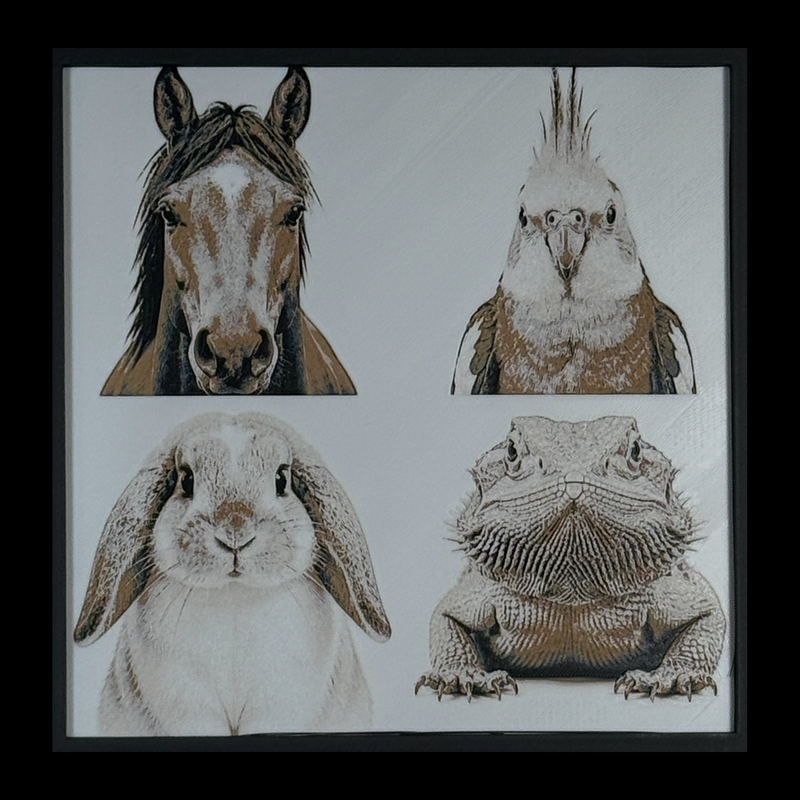
Memorial Art for Horses, Birds, Rabbits, Reptiles, and Other Companions
A companion does not need to be a dog or cat for the relationship to deserve a personal...
Pet Collar Memorial Display: How to Keep the Collar Safely at Home
The original collar should remain with the family. Photograph it, measure it, confirm the current display format, and...
Wedding Photo Gifts for Parents and Grandparents
The strongest parent or grandparent gift uses the wedding photograph that belongs to that relationship—not simply the couple's...