How to Choose the Best Photo for a Pet Memorial Portrait

The best pet memorial photograph is not always the sharpest image in the camera roll.
It is also not automatically the image in which the companion sits formally and looks directly at the camera.
The strongest source balances three things:
- It feels like the companion.
- It preserves the features the family recognizes.
- It contains enough genuine visual information to become strong layered art.
A technically clear photograph may feel generic. A deeply meaningful photograph may be too distant, blocked, dark, or blurred to carry the entire memorial by itself.
WTx3D reviews the actual source before production, prepares each accepted image individually, and provides a digital proof before fabrication begins. The customer does not need to make the final technical judgment alone.
Explore Pet Memorial Custom Photo Art.
The best photograph balances meaning and recognition
Begin with two questions.
Does the photograph feel like the companion?
Ask:
- Is the expression familiar?
- Does the pose show personality?
- Does the image preserve an important relationship, routine, place, or life stage?
- Is this the photograph the family returns to?
- Would a technically clearer image feel less personal?
Does the photograph contain enough usable information?
Ask:
- Is the companion large enough in the frame?
- Are the face or defining features visible?
- Are important markings present?
- Is the subject reasonably in focus?
- Does the lighting preserve real detail?
- Is the companion heavily blocked?
- Does the background merge with the subject?
- Is there room for crop adjustments?
- Is an original file available?
The best candidate performs well in both areas.
A meaningful image with limitations may still deserve review. A clear but less emotional photograph may serve as the anchor portrait while the favorite candid becomes a second image in a four-photo memorial.

Start with three finalists, not an entire camera roll
Gather a small, intentional group of candidates.
A useful shortlist often includes:
- Anchor portrait: the clearest recognizable face or defining view
- Personality or relationship image: the photograph that feels most emotionally true
- Life-stage or place image: a meaningful age, activity, location, or daily routine
A fourth image may show another companion, favorite object, or additional life stage.
Do not send dozens of unexplained photographs and expect the studio to guess which memories matter most. A short note identifying the first choice and why it matters helps WTx3D understand the customer’s priorities.
Test 1: Does the photograph preserve identity?
The source should show the features that make the individual companion recognizable.
Depending on the animal, those features may include:
- Eyes
- Ears
- Nose, muzzle, mouth, or beak
- Head shape
- Mane
- Whisker area
- Coat, feather, or scale pattern
- Facial markings
- Body shape or stance
- Scar or unique physical feature
- Collar, tack, or meaningful accessory
- Familiar posture or expression
Not every photograph needs every feature.
A side profile may preserve one eye, the nose or beak line, ear shape, and head silhouette perfectly. A horse memorial may depend on stance, mane, markings, or the relationship with the rider. A bird may depend on the eye, beak, color blocks, and body outline.
The correct question is not “Does the pet face the camera?” It is “Will the family still recognize this companion after the photograph becomes layered art?”
Test 2: Is the companion large enough in the frame?
A large digital file can still contain a tiny subject.
Look at how much of the photograph the companion actually occupies.
A closer image usually preserves more:
- Eye and facial detail
- Markings
- Ear or head shape
- Coat, feather, or scale transitions
- Expression
- Accessories
A distant photograph may still be meaningful when the location or activity is part of the story. It may work better as a supporting image in a Custom Photo 4-Pack than as the single anchor portrait.
Test 3: Are the defining features visible rather than hidden?
Common problems include:
- Ear cut off by the crop
- Face hidden behind furniture, cage bars, fencing, glass reflection, or another animal
- Eyes lost in shadow
- Muzzle or beak obscured
- Long fur covering the face
- Pet turned so far away that identity is lost
- Person or object blocking an important marking
WTx3D may simplify a background or improve separation, but it cannot reliably reveal a feature that the original photograph never captured.
Choose another source when the missing feature is essential to recognition.
Tests 4 and 5: Does the lighting preserve detail, and does the subject separate from the background?
A dramatic photograph may look beautiful on a phone while hiding important information.
Useful lighting reveals the face, body edge, markings, and texture.
Pay special attention to:
- Black pet on a dark blanket
- White pet on bright bedding
- Long fur against patterned furniture
- Bird behind cage bars
- Reptile behind reflective glass
- Horse behind fencing
- Bright window behind the head
- Strong colored indoor lighting
A perfect blank wall is not required. WTx3D normally removes or simplifies the background when that creates a stronger result.
The source still needs enough real information to separate the companion from the scene.
For old, dark, damaged, or severely blurred sources, read Can an Old, Dark, or Blurry Pet Photo Become Memorial Art?.
Test 6: Is there room for a clean crop?
WTx3D normally crops and centers the subject for the selected art format.
The original source is easier to prepare when it leaves some room around important features such as:
- Ears
- Head
- Mane or long fur
- Body or stance
- Tail when important
- Collar or tack
- Paws
- Favorite object
- Person included in the image
Avoid aggressive pre-cropping when possible.
A tightly cropped ear, paw, mane, or partial face cannot always be rebuilt accurately. Sending the original file gives WTx3D more flexibility.
Test 7: Do you have the strongest original file?
Use the original phone, camera, scan, or authorized photographer file whenever possible.
It normally contains more genuine detail than:
- Screenshot
- Social-media download
- Message preview
- Repeatedly saved copy
- Heavily filtered image
- Watermarked file
Compression may reduce detail around the eyes, fur, feathers, scales, markings, ears, and subject edges.
A screenshot may still be reviewed when it is the only available source. When an enhanced or restored version exists, send both the original and the edited file so WTx3D can determine which source produces the strongest and most faithful result.
The customer must own the image or have permission to use it for the custom order.

Choose the image type that matches the story
Close portrait
Choose a close portrait when facial identity, eyes, expression, and markings are the center of the memorial.
This usually preserves the greatest individual detail.
Side profile or three-quarter view
Choose this when the visible eye, nose or beak line, ear shape, head silhouette, and natural pose are highly recognizable.
The companion does not need to face the camera directly.
Full-body photograph
Choose a full-body image when stance, body shape, coat pattern, activity, tack, or environment is essential.
The companion still needs to occupy enough of the photograph to remain recognizable.
Pet with owner or family
Choose a relationship image when the bond is the main story.
It works best when the people and companion are close together, faces are visible, lighting is reasonably consistent, and the composition is not overcrowded.
A four-photo memorial may be stronger when the companion needs an individual anchor portrait and the relationship deserves its own position.
What if the favorite photograph is not the clearest?
Do not automatically discard it.
Use one of three routes.
Route 1 — Use the favorite photograph
Choose it when the limitations are manageable and the emotional value clearly outweighs another source.
Route 2 — Use the technically stronger photograph
Choose it when the favorite image lacks enough real information to preserve the companion’s identity.
Route 3 — Use both
Use the clearer source as the anchor portrait and the favorite image as the personality, relationship, place, or life-stage image in a Custom Photo 4-Pack.
This often creates a more honest memorial than forcing one photograph to do every job.
One companion or several?
One clear companion usually allows the most room for identity and detail.
Several animals may work together when:
- They are already in one photograph
- Faces are large enough
- Lighting is reasonably consistent
- Bodies and coats can be separated
- No companion is heavily blocked
- The image is not crowded
Separate modular portraits are often stronger when each companion deserves individual space or when the animals were never photographed together.
WTx3D does not automatically build a natural-looking group scene from unrelated source photographs.
For the complete four-image planning method, read Pet Memorial 4-Pack Guide: Four Images That Tell Their Story.
Species changes the best type of photograph
The same selection principles apply across companions, but the defining features differ.
- Dogs: eyes, ears, muzzle, markings, coat shape, posture, expression
- Cats: eyes, ears, profile, face pattern, whisker area, coat, familiar pose
- Horses: eye, ears, mane, markings, stance, tack, rider, meaningful place
- Birds: eye, beak, head profile, feather color blocks, body outline
- Rabbits and small animals: close face, eyes, ears, nose, body shape
- Reptiles: eye, head shape, scale pattern, body outline, limited glass reflection
For species beyond dogs and cats, read Memorial Art for Horses, Birds, Rabbits, Reptiles, and Other Companions.
What WTx3D can prepare—and what it cannot invent
WTx3D may prepare an accepted image through:
- Background removal or simplification
- Crop and centering
- Upscaling when useful
- Brightness and contrast adjustment
- White- and dark-level adjustment
- Sharpness improvement where genuine edges remain
- Subject separation
- Palette evaluation
- Manual layered-art preparation
The process cannot guarantee recovery of invisible eyes, missing markings, hidden body parts, or exact facial detail that does not exist in the source.
When a photograph cannot produce a strong result, WTx3D may recommend another image rather than forcing a weak design into production.
A practical selection process
Step 1 — Gather three to five meaningful candidates
Include different image roles rather than nearly identical photographs.
Step 2 — Identify the clearest recognizable anchor
Find the source with the strongest face, head shape, markings, or defining view.
Step 3 — Identify the most meaningful personality or relationship image
Choose the photograph that shows routine, expression, family, activity, or another companion.
Step 4 — Use the best original files
Include restored versions separately rather than replacing the originals.
Step 5 — Choose one portrait or four positions
Choose one portrait when one image clearly carries the identity and story.
Choose a Custom Photo 4-Pack when the anchor face, personality, relationship, place, or life stage each deserve separate space.
The proof is the final photo test
The customer does not approve the source blindly.
WTx3D prepares the accepted image and provides a digital proof showing the planned result.
Review:
- Crop
- Face or defining view
- Eyes, ears, beak, mane, or head shape
- Markings
- Coat, feather, or scale treatment
- Background
- Color direction
- Accessory
- Text when included
- Frame path
- Overall presentation
Up to two reasonable proof revisions are included.
Nothing enters production until the final proof is approved.
If the proof still does not produce a strong and recognizable result, another photograph is better than forcing a weak memorial into production.

Best-photo checklist
Before uploading, confirm:
- The photograph feels like the companion
- The companion is large enough in the frame
- Defining features remain visible
- Important details are not heavily blocked
- Lighting preserves useful information
- The subject separates from the background
- There is room for crop adjustments
- The strongest original file is available
- The customer owns the image or has permission to use it
- One portrait or a four-photo structure has been chosen intentionally
- Difficult or unusual sources have been routed for review
Choose the image that preserves both identity and meaning
The best pet memorial source is not defined by one rigid technical rule.
It is the photograph that still feels like the companion and contains enough genuine information to preserve identity in layered art.
Start with a small group of candidates.
Choose the clearest recognizable anchor.
Keep the meaningful candid or relationship image.
Use the original files.
Then let WTx3D prepare the source and show the planned result before fabrication begins.
Upload the Strongest Photo for a Pet Memorial Portrait
For a severely damaged source, tiny subject, separate-photo composite, unusual companion, more than four essential photographs, professional-image permission question, physical keepsake concept, or fixed presentation date, use the WTx3D contact page before ordering.
Frequently Asked Questions
What is the best photo for a pet memorial portrait?
The strongest source combines emotional meaning with enough visible detail to preserve the companion’s face or defining view, markings, pose, and identity.
Does the pet need to face the camera?
No. A forward-facing image often shows the most facial detail, but a three-quarter view, side profile, candid pose, or resting photograph may work when the defining features remain clear.
Is a close portrait better than a full-body photograph?
A close portrait usually preserves more facial detail. A full-body image may be stronger when stance, coat pattern, activity, tack, or meaningful setting is essential.
Can I use a photograph of the pet with the owner?
Yes. It works best when the pet and people are close, visible, similarly lit, and not crowded. A four-photo set may be stronger when the pet also needs an individual portrait.
How much room should be around the pet?
Some space around the ears, head, mane, coat, body, collar, tack, or important object gives WTx3D flexibility to crop and center the artwork without cutting off defining features.
Should I upload the original or a screenshot?
Use the original file whenever possible. Screenshots and compressed copies may contain less genuine detail around the eyes, fur, feathers, scales, markings, and subject edges.
Can a dark or blurry photograph work?
It may work when useful visual information remains. Old, dark, damaged, or severely blurred sources should be reviewed directly because missing detail cannot always be recovered accurately.
Can I send more than one possible photograph?
Yes. A small, organized set is useful. Identify the first choice, clearest anchor portrait, meaningful candid or relationship image, and any important life-stage photograph.
What if my favorite photograph is not the clearest?
The favorite image may still be reviewed. It can also become a personality or relationship image in a four-photo set while a clearer source serves as the anchor portrait.
Can several pets appear in one portrait?
They may work when they are close, clear, similarly lit, and not crowded. A Custom Photo 4-Pack may preserve more identity when each companion deserves individual space.
Can WTx3D remove the background?
WTx3D normally removes or simplifies the background when that creates a stronger layered result. Background preparation cannot reconstruct unlimited hidden or missing features.
What happens after I choose the image?
WTx3D reviews and prepares the source, creates a digital proof, and waits for approval. Nothing enters production until the final proof is approved.
Frequently Asked Questions
How long does a custom piece take?
Most custom orders are proofed within 2-3 business days. Once you approve the proof, production and hand-finishing take about 7-14 business days before your piece ships.
What sizes and frames are available?
Every piece is available in a 4" × 4" or 8" × 8" layered format, and you can choose between our standard black frame or the Signature frame upgrade.
Do I get to see the design before it is made?
Yes. We send a digital proof for every custom order and nothing goes into production until you approve it.
Turn Your Photo Into Framed 3D Layered Art
Upload one photo, approve the proof, and we hand-finish your layered artwork in our West Texas studio.

Keep Reading
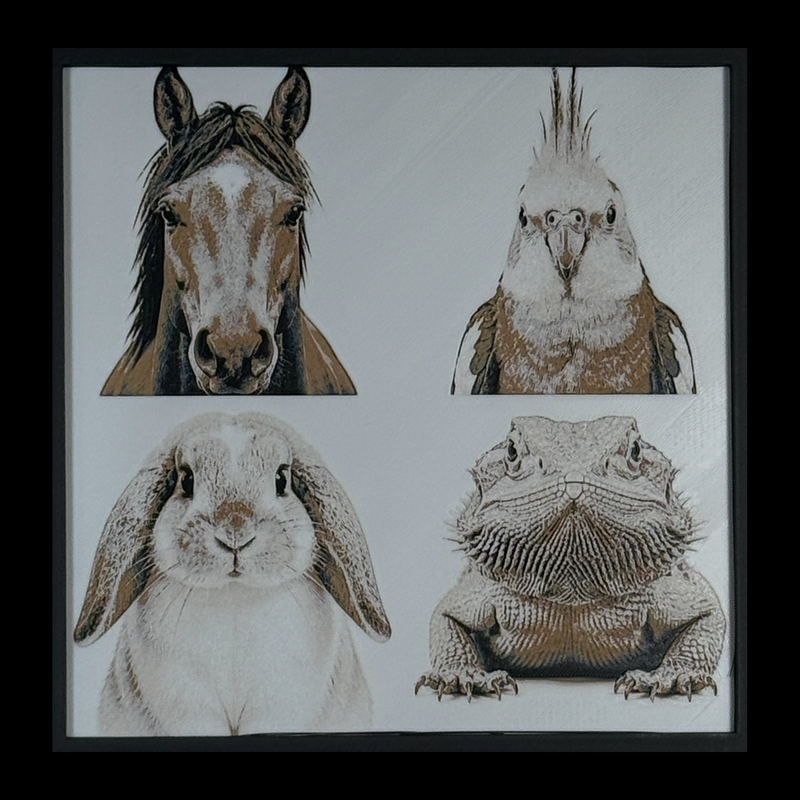
Memorial Art for Horses, Birds, Rabbits, Reptiles, and Other Companions
A companion does not need to be a dog or cat for the relationship to deserve a personal...
Pet Collar Memorial Display: How to Keep the Collar Safely at Home
The original collar should remain with the family. Photograph it, measure it, confirm the current display format, and...
Wedding Photo Gifts for Parents and Grandparents
The strongest parent or grandparent gift uses the wedding photograph that belongs to that relationship—not simply the couple's...