Best Wedding Photos for Custom Layered Art

The strongest wedding photograph for WTx3D Custom Photo Art usually has one clear couple or main subject, faces large enough to read, useful focus, manageable lighting, visible contrast, minimal obstruction, and enough space for a thoughtful crop. An original authorized file is better than a screenshot whenever it is available.
Professional photography is not required. A clear phone photograph or meaningful candid can work very well. A professionally photographed image can still be difficult when the couple is tiny, motion-blurred, heavily blocked, severely underexposed, or cropped through important features.
The real question is:
Can this photograph become strong dimensional layered art?
WTx3D reviews every submitted image from the perspective of the finished piece. If a different crop, color direction, cleanup approach, or source photo would create a stronger result, the studio will explain that before fabrication begins.
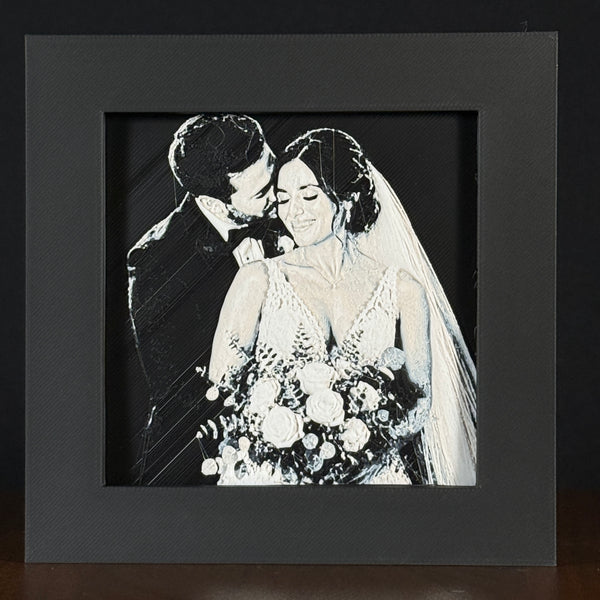
Explore Wedding & Anniversary Custom Photo Art.
First decide what job the photograph needs to do
Not every worthwhile wedding image needs to serve as the main portrait.
Anchor portrait
The anchor is the strongest candidate for one larger piece. It normally gives the couple enough visual space for facial expression, hair, clothing, veil, bouquet, and pose.
A close or half-length couple portrait is often the most dependable anchor.
Relationship or moment image
A first look, laugh, kiss, dance, toast reaction, or candid interaction may carry more emotional meaning than the formal portrait. It can become the anchor when the visible faces and body positions remain clear, or it can support the story in a 4-Pack.
Complete-group image
A family or wedding-party photograph preserves connection. It may be excellent as a supporting piece even when each face is too small for the same level of detail as a close portrait.
Place or detail image
The church, venue, home, landscape, bouquet, rings, invitation, or another meaningful object can represent the setting or symbolism of the day. These images often work best as separate positions rather than being forced into the main portrait.
This role-based approach prevents one crowded photograph from being asked to preserve the couple, family, venue, and every detail at once.

Sort candidates into three practical groups
| Candidate type | What it usually looks like | Best next step |
|---|---|---|
| Strong anchor candidate | Clear couple or main subject, readable faces, useful contrast, enough crop room, original file available | Strong starting point for one portrait or the lead position in a 4-Pack |
| Meaningful supporting candidate | Wider ceremony scene, group, venue, pet, detail, or candid with less facial prominence | Consider as a separate 4-Pack position or companion piece |
| Review-required candidate | Tiny faces, heavy blur, missing features, severe darkness, featureless highlights, obstruction, watermark, uncertain rights, or composite request | Contact WTx3D or provide a stronger alternate before relying on it |
A review-required image is not automatically rejected. Older, dark, or irreplaceable photographs may still deserve careful cleanup and evaluation. The label simply means the result should not be promised from the thumbnail alone. For deeper guidance, read Old, Dark, or Blurry Wedding Photos.
Use an eight-part source-photo check
1. Meaning
Begin with the photograph the couple genuinely values.
Technical quality matters, but an emotionally empty image is not automatically better because it is sharper. The strongest choice is where meaning and usable information meet.
Ask:
- Does this image represent the couple accurately?
- Is the expression or moment important?
- Will the photograph still matter years from now?
- Is the image being chosen because it is meaningful, or only because it is available?
2. Subject and face size
Subject size often matters more than the total pixel dimensions of the file.
A large digital image can still contain very small faces when the couple occupies only a small part of a wide ceremony scene. Enlarging the file cannot recreate facial information that was never captured at a useful scale.
Look for:
- Eyes and facial features that can be seen
- A couple that occupies a meaningful part of the frame
- Enough room for hair, veil, shoulders, bouquet, or pose
- A composition that does not require an extreme crop to find the subjects
A wide ceremony photograph may still be valuable as a separate venue or moment piece beside a closer portrait.
3. Focus and motion
The important features should be reasonably sharp.
Mild softness may be manageable. Severe motion blur across the eyes, mouth, hairline, hands, or clothing can remove information that sharpening cannot restore.
Candid photographs work best when the emotion is visible and the movement has not erased the subject.
4. Lighting and retained detail
Good lighting does not require a studio. It requires enough visible information in the important areas.
Watch for:
- Faces lost in deep shadow
- Strong backlighting that turns the couple into silhouettes
- Colored reception lights that heavily distort skin tones
- Bright highlights that erase dress or facial detail
- Uneven lighting that makes one person clear and another difficult
WTx3D may adjust brightness, whites, darks, contrast, and color direction. Those adjustments can reveal information that exists; they cannot guarantee detail that the camera never captured.
5. Obstruction
Important features should not be hidden by another person, microphone, bouquet, hand, veil, floral structure, furniture, or décor.
Minor distractions can sometimes be simplified. Missing facial features, bodies, or essential clothing cannot automatically be rebuilt accurately.
A strong source keeps the important people visible without relying on major reconstruction.
6. Subject separation
Hair, clothing, skin, flowers, and the background should not collapse into one indistinct area.
Useful separation is especially important when the image includes:
- Dark suits against dark walls
- Dark hair against a black or shadowed background
- White dresses against a bright sky or pale wall
- Veils crossing a dress, face, or window
- Light clothing against an overexposed background
WTx3D may adjust tonal separation or recommend a different color direction when it will represent the subjects more clearly.
7. Crop space
Leave some room around the features the artwork needs to preserve.
Helpful space includes:
- Hair and head
- Veil
- Shoulders
- Hands
- Bouquet
- Dress shape
- Important architecture or background context
Avoid aggressive pre-cropping when the original file is available. A cut head, missing veil edge, removed hand, or partial bouquet cannot always be reconstructed.
8. File quality and permission
Use the strongest original or authorized file available.
An original file generally contains more real information than:
- A screenshot
- A social-media download
- A small message preview
- A watermarked gallery image
- A file repeatedly saved through several apps
- A heavily filtered copy
Compression can remove genuine detail around eyes, hair, lace, flowers, and clothing edges.
Possession of a file does not always establish reproduction rights. Upload only images you own or have permission to use. Professional wedding photographs may remain protected under the photographer’s agreement even when the couple can view or download them.
Which wedding-photo types work best?
Close couple portraits
A clear close or half-length portrait is usually the strongest all-around choice for one larger piece because it gives the artwork more room for identity and expression.
It is especially useful when the buyer cares about:
- Faces and emotion
- Hair and makeup
- Suit or uniform separation
- Veil and bouquet
- Hands and pose
- A quiet focal composition
The portrait does not need to be formal. A close first look, embrace, laugh, forehead touch, or dance can be equally strong.
Full-body portraits
A full-body image may work when the dress, pose, or setting is essential and the couple still occupies enough of the frame.
Expect facial detail to be less dominant than in a close portrait. Choose the format based on what matters most: the complete silhouette and setting, or the faces.
Ceremony photographs
A ceremony photograph may work when the couple is large enough and the important action is visible.
Strong ceremony moments include:
- Vow or ring exchange
- First kiss
- Walking down the aisle
- Couple at the altar
- Religious or symbolic ritual
Common difficulties include distance, backlighting, microphones, officiants, floral structures, guest obstruction, and tiny faces.
When the church or venue matters as much as the couple, use a close portrait for one position and the setting for another.
Candid, first-look, and dance photographs
Candid images can be excellent because they show the couple’s actual personality.
They work best when:
- The visible faces remain clear
- Motion blur is limited
- The gesture or emotion is understandable by itself
- Hair or veil does not block the essential features
- The couple separates from the crowd or background
The couple does not need to look directly at the camera. A meaningful side profile or three-quarter view may work when the visible features are strong.
Family and wedding-party groups
There is no single universal maximum number of people. The real limitation is how much visual space each face receives.
A group is stronger when:
- People stand close enough together
- Faces are visible and similarly lit
- Important people are not blocked
- The group occupies most of the useful frame
- The background does not overwhelm the subjects
A complete group may preserve connection without preserving the same individual detail as separate portraits. When identity matters, a Custom Photo 4-Pack or several framed pieces may be stronger than one crowded image.
People from unrelated photographs are not automatically combined into a new natural-looking group portrait. Separate-photo compositing requires review.
Venue, architecture, and meaningful details
A church, chapel, venue, family property, hotel, garden, beach, mountain setting, bouquet, rings, or invitation can become its own piece when the source is authorized and visually clear.
Architecture usually benefits from more room because windows, rooflines, columns, landscaping, and signs may be important to recognition. Tiny lettering or protected logos may require simplification or review.
Venue and detail photographs are often strongest as separate 4-Pack positions beside a close couple portrait.
Wedding-specific contrast: white dresses, dark suits, veils, and small details
White dresses and bright highlights
A white dress can produce beautiful layered art when the source retains folds, shadows, bodice structure, sleeve edges, and fabric transitions.
A featureless white area may not contain recoverable lace, beading, or embroidery detail. WTx3D can adjust highlights and contrast, but it cannot recreate exact fabric information that was never captured.
Dark suits, dark hair, and black clothing
Dark subjects can work well when the jacket, hair, face, and background remain separated. A black suit against a dark reception wall may require stronger tonal separation or a different color direction.
Veils, lace, flowers, jewelry, and rings
These details may remain when they are large enough and clearly photographed. Expect the main shape and visual role to survive more reliably than microscopic stones, engraving, repeated lace patterns, or individual tiny petals.
Long wording and small typography are normally better placed on a suitable frame or reverse backing than forced into the layered image.

Backgrounds: what WTx3D may change
Most Custom Photo Art uses a clean black foundation because it supports the layered structure and creates strong subject separation.
WTx3D may remove or simplify the original background when that creates a cleaner result. This can help with reception clutter, crowds, furniture, signs, cars, distracting décor, uneven lighting, or colors that merge with clothing and hair.
Background cleanup does not mean unlimited reconstruction. A standard order does not automatically include:
- Building a completely new wedding scene
- Reconstructing missing bodies or features
- Inserting people from unrelated images
- Endless background experiments
- Major compositing without review
An alternate treatment may be considered when it clearly improves the design or is necessary for separation.
What WTx3D can improve—and what it cannot promise
WTx3D may improve or adjust:
- Background simplicity
- Crop and placement
- Brightness, whites, and darks
- Contrast
- Sharpness where genuine information exists
- Subject separation
- Color direction
- Overall layered presentation
WTx3D cannot promise:
- That every photograph will work
- Exact facial reconstruction
- Perfect restoration
- Recovery of information that was never captured
- Unlimited lace, jewelry, text, or architectural detail
- A natural composite from unrelated photographs
- Exact screen-to-material color matching
- Acceptance of every source file
The studio uses its experience and judgment to create the strongest result the source allows. For the complete preparation and proofing workflow, read How WTx3D Turns Wedding Photos Into Framed Layered Art.
Still deciding which display format fits the photograph? Compare Custom Wedding Photo Art vs Canvas, Prints, and Photo Books.
Choose one image or move the story into four pieces
Choose one larger portrait when a single source clearly captures the couple and should remain the focal point.
Choose a Custom Photo 4-Pack when separate space is needed for:
- A close portrait and wide ceremony scene
- The couple and important family members
- Children or pets
- The venue or home
- A meaningful detail
- Several stages of the relationship
- One difficult historical image balanced by clearer photographs
The four images do not need to be different, but each position should have an intentional role. For the one-versus-four purchase decision, read One Wedding Portrait or a Four-Photo Story?. For the complete selection workshop, read How to Choose Four Wedding Photos That Tell the Whole Story.
Build a practical shortlist before uploading
When several images compete for one portrait, compare three to five candidates privately:
- Emotional favorite: the image that matters most
- Technical backup: the clearest close portrait
- Candid option: a meaningful interaction or moment
- Context option: ceremony, group, venue, or detail
- Alternate crop or file: the same moment in a stronger original version, when available
For one portrait, choose the file that best balances meaning and usable detail. For a 4-Pack, give each final image a distinct story role.
When two candidates are equally important but technically very different, contact WTx3D before ordering rather than assuming the weaker file will produce the same result.

Final upload checklist
Before checkout, confirm:
- The photograph is meaningful
- The important faces or subjects are large enough
- Focus preserves the essential features
- Lighting retains useful facial, dress, suit, and background detail
- Important people are not blocked
- Hair, clothing, skin, and background have useful separation
- The crop leaves room for the essential head, veil, hands, bouquet, or setting
- The strongest original or authorized file is being used
- The image is not an unauthorized watermarked preview
- Names and dates are written separately and spelled correctly
- The cart shows the intended image, product, size, and frame
- A fixed presentation date has been reviewed with WTx3D before ordering
You do not need to decide alone whether the image is perfect. WTx3D reviews every submitted source before production and will recommend another crop, treatment, color direction, or photograph when that protects the quality of the finished piece.
Start with the photograph that matters—and the file that supports it
The best wedding source image is where emotional value and usable visual information meet.
Choose the photograph the couple genuinely cares about. Send the strongest original or authorized file available. Leave enough room for thoughtful preparation. Then let WTx3D review what the image can become before anything is fabricated.
Create Wedding & Anniversary Custom Photo Art
For an old or damaged photograph, professional-image permission question, very large group, separate-photo composite, important venue detail, severe darkness or overexposure, more than four essential images, unusual size, or fixed event date, use the WTx3D contact page before ordering.
Frequently Asked Questions
What is the best wedding photograph for WTx3D Custom Photo Art?
A clear close or half-length couple portrait is usually the strongest all-around source. It should have faces large enough to read, useful focus, manageable lighting, minimal obstruction, visible separation, and enough crop room.
Does the wedding photograph need to be professionally taken?
No. Clear phone photos and meaningful candids may work very well. WTx3D evaluates the actual subject size, focus, lighting, contrast, crop, and real detail in the file rather than the camera label.
Is a close portrait better than a full-body wedding photo?
A close portrait usually preserves more facial detail. A full-body photograph may be stronger when the dress, pose, or setting is essential and the couple still occupies enough of the image.
Can a first-look, kiss, or dance photograph work?
Yes. A candid can be an excellent source when the visible faces and body positions remain clear, motion blur is limited, and the moment can be understood without the rest of the sequence.
Can a wide ceremony photograph work?
It may work when the couple remains large enough and the important action is visible. A wide ceremony scene often works better as a separate 4-Pack position beside a closer couple portrait.
Can WTx3D preserve a white wedding dress?
A white dress can work very well when the source retains shadows, folds, texture, and separation. A featureless overexposed area may not contain recoverable lace, beading, or fabric detail.
Can dark suits, dark hair, or black clothing work?
Yes. They may require stronger tonal separation, contrast adjustment, a different color direction, or a carefully selected background treatment so the subjects do not disappear into the foundation layer.
How many people can appear in one wedding portrait?
There is no universal maximum. The practical limit depends on how much space each face receives, whether everyone is visible, and whether individual identity matters. Larger groups may be stronger as separate pieces or a 4-Pack.
Can WTx3D remove a busy wedding or reception background?
WTx3D may remove or simplify the background when that improves the design. Standard background cleanup does not include unlimited reconstruction, automatic creation of a new scene, or insertion of people from unrelated photographs.
Should I upload a screenshot from the photographer’s gallery?
Use the original authorized file whenever possible. Screenshots may contain less detail, added compression, interface elements, or watermarks. You must also own the reproduction rights or have permission to use the photograph.
Should I crop the wedding photograph before uploading it?
Avoid aggressive pre-cropping when the original file is available. Extra space gives WTx3D more room to preserve hair, veil, hands, bouquet, clothing, and important setting details.
What if my favorite wedding photo is dark, blurry, or old?
WTx3D will review and improve it where practical before deciding that another source is needed. Exact restoration or facial reconstruction cannot be guaranteed. Send the strongest original and any restored version available.
Can people from separate wedding photographs be combined?
Not automatically. Building a natural-looking composite from unrelated files may require substantial custom design work and may not create the strongest result. Separate framed portraits or a 4-Pack often preserve each person more clearly.
What happens when the photograph is not strong enough?
WTx3D may recommend another crop, treatment, color direction, or source image. The studio will not force a weak design into production when another photograph would clearly create a better finished piece.
Frequently Asked Questions
How long does a custom piece take?
Most custom orders are proofed within 2-3 business days. Once you approve the proof, production and hand-finishing take about 7-14 business days before your piece ships.
What sizes and frames are available?
Every piece is available in a 4" × 4" or 8" × 8" layered format, and you can choose between our standard black frame or the Signature frame upgrade.
Do I get to see the design before it is made?
Yes. We send a digital proof for every custom order and nothing goes into production until you approve it.
Turn Your Photo Into Framed 3D Layered Art
Upload one photo, approve the proof, and we hand-finish your layered artwork in our West Texas studio.
Shop The Look
Keep Reading
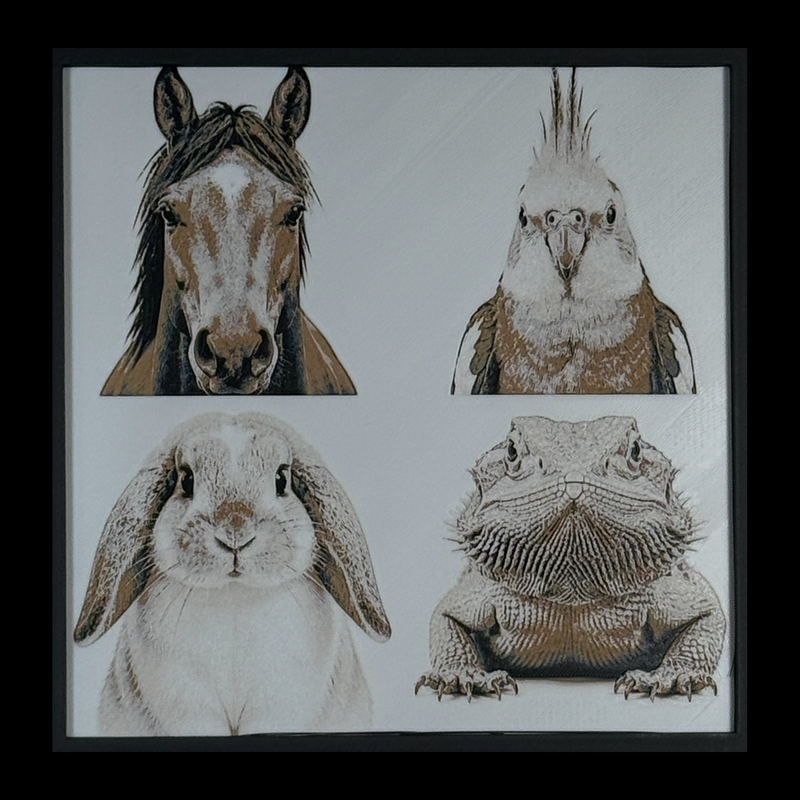
Memorial Art for Horses, Birds, Rabbits, Reptiles, and Other Companions
A companion does not need to be a dog or cat for the relationship to deserve a personal...
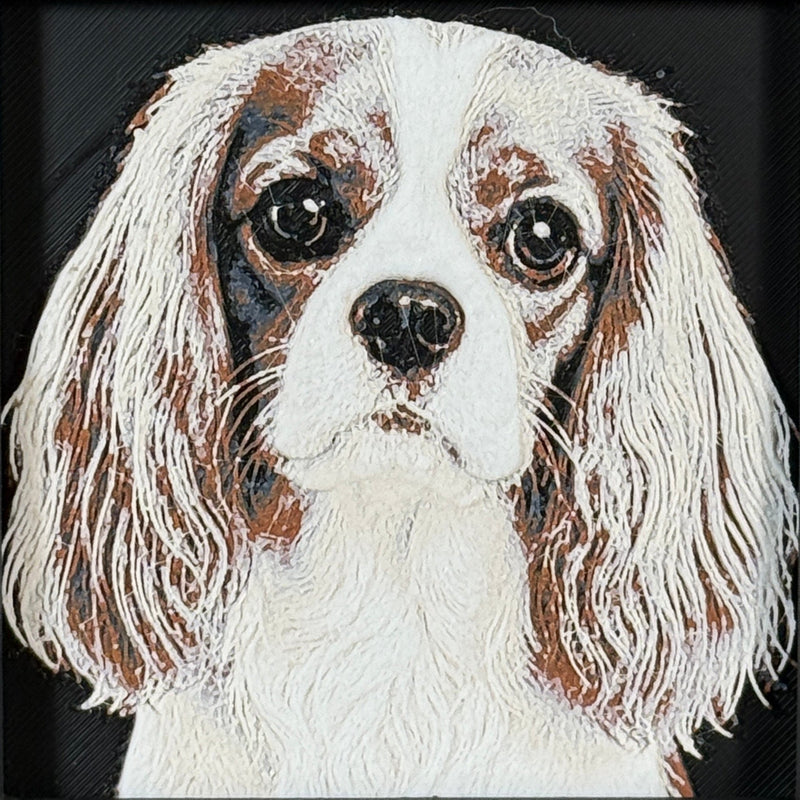
Pet Collar Memorial Display: How to Keep the Collar Safely at Home
The original collar should remain with the family. Photograph it, measure it, confirm the current display format, and...
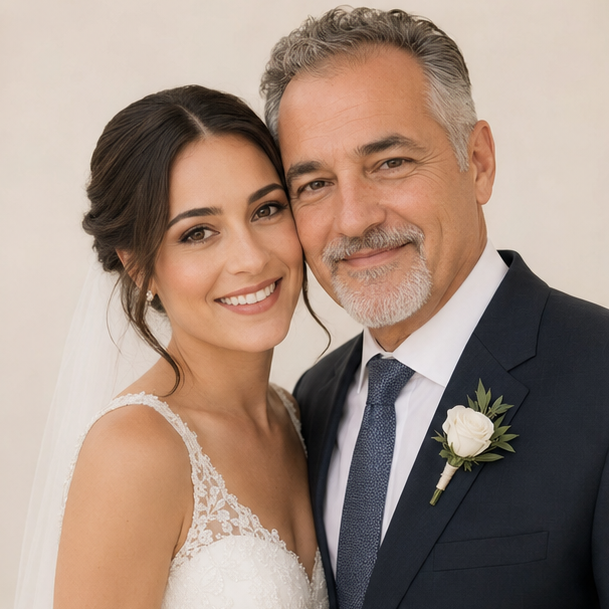
Wedding Photo Gifts for Parents and Grandparents
The strongest parent or grandparent gift uses the wedding photograph that belongs to that relationship—not simply the couple's...