Old Family Photos: Can They Become Custom Art?

The family photograph with the greatest meaning may also be the hardest one to use.
It may be faded, scratched, dark, tightly cropped, soft, printed decades ago, or saved only as a small digital copy. It may also be the only photograph that preserves a particular person, generation, home, or period of family life.
That does not automatically make it unusable.
The honest first question is not, “Can this be perfectly restored?”
It is:
What real information still exists, and can that source become strong dimensional layered art?
WTx3D reviews the source, prepares it where practical, and shows the proposed result in a digital proof before production.
Explore Family Memories Custom Photo Art.
For a normal current photograph, begin with Best Family Photos for Custom Layered Art. This guide owns the harder archive-source decision: what survives, how to digitize it, what enhancement changed, and which role the older image can honestly perform.
First identify what kind of source you have
The path depends partly on the file itself.
| Source type | Best next step |
|---|---|
| Original digital file | Send the highest-quality version without new filters or aggressive cropping |
| Flatbed scan | Use the clearest scan that includes the full print |
| Photograph of a print | Capture it straight on, in even light, without glare or hand shadows |
| Screenshot or social-media copy | Search for the original first; submit the screenshot only when no stronger source exists |
| Enhanced or restored version | Send it together with the original so WTx3D can compare faithfulness and usable detail |
| Professional print or photographer file | Confirm that the customer owns the reproduction rights or has permission |
Do not discard or alter the original family print while the source is being evaluated.


Three questions decide whether to continue
1. Are the important people still recognizable?
Look for:
- Face shape
- Eyes or eye area
- Hair
- Clothing
- Body position
- Relationship between the people
- Enough scale to understand who is present
The image does not have to be crisp. The people do need to remain identifiable enough for the intended role.
2. What information is actually missing?
There is a difference between weak contrast and missing features.
Fading may leave the real shapes intact.
A scratch across the background may be easier to simplify than a tear through an eye.
A dark jacket may still have visible edges.
A completely blurred or blocked face may contain little authentic information to recover.
3. Is there a better source somewhere else?
Before rebuilding the weakest copy, search for:
- Duplicate print
- Album copy
- Negative or slide
- Earlier scan
- Photographer file
- Relative’s copy
- Old computer or phone
- Cloud backup
- Another photograph from the same day
- A similar portrait from the same stage of life
Finding a stronger source is often more valuable than applying heavier enhancement to a poor one.
Different problems require different decisions
| Source problem | What may help | What cannot honestly be promised |
|---|---|---|
| Fading or low contrast | Whites, darks, contrast, crop, separation, color direction | Exact recovery of the original physical colors |
| Dark exposure | Brightness, tonal separation, background simplification | Detail from completely featureless shadows |
| Mild softness | Careful sharpness improvement | Exact reconstruction of severely blurred faces |
| Scratches, spots, or tears | Cleanup where authentic detail remains | Invisible repair through missing eyes or defining features |
| Tight crop | Recomposition around the surviving image | Rebuilding missing heads, hands, bodies, or clothing automatically |
| Tiny faces | Crop, upscaling, or use as a supporting image | Authentic facial information the camera never captured |
| Screenshot or compressed copy | Review, upscaling, background cleanup | Original-file detail or automatic reproduction permission |
| Strong obstruction | Minor simplification when the obstruction is nonessential | Guaranteed detail hidden behind another person or object |
The same word—“old”—can describe very different technical problems. The actual source decides the route.
Digitize the print without adding new damage
When the only source is a physical print:
- Keep the print flat
- Capture it straight on
- Use even light
- Avoid glare
- Avoid shadows from the phone, camera, or hands
- Include the complete photograph
- Keep the camera steady
- Do not add heavy filters
- Do not crop aggressively
- Save the highest-quality file available
A careful flatbed scan may also work.
If several scans or captures are available, send the strongest options rather than choosing only one without comparison.
Search for the best source before restoring the weakest one
An archive search is part of the project, not wasted time.
Ask:
- Which relative may have the original?
- Did the photographer provide a digital file?
- Is the image in another album?
- Does a sibling have a less-faded copy?
- Is there another frame from the same gathering?
- Was the print scanned before it was damaged?
- Does an older computer or cloud account contain the file?
A different source may preserve a clearer face, uncropped head, better clothing detail, or a less-obstructed relationship.
Send the original and enhanced version
Modern enhancement and AI-assisted restoration may improve an older image.
It may also change:
- Eyes
- Expression
- Teeth
- Hair
- Hands
- Clothing
- Background objects
- Another family member
The original gives WTx3D a reference point.
Send:
1. The strongest original
2. The enhanced or restored version
3. Any alternate source from the same period
WTx3D can compare the files and use whichever source or treatment produces the strongest and most faithful layered result.
What WTx3D may prepare
Every accepted custom image is prepared individually.
The broader preparation and proof workflow is explained in How to Turn Family Photos Into Framed 3D Layered Art.
Depending on the source, preparation may include:
- Background removal or simplification
- Upscaling when needed
- Brightness adjustment
- White- and dark-level adjustment
- Contrast
- Sharpness adjustment where genuine edges remain
- Crop and placement
- Subject separation
- Color-direction evaluation
- Manual layered-art preparation before proofing
This work can strengthen information that exists.
It does not turn a source with no authentic detail into a perfect modern portrait.
What WTx3D cannot guarantee
WTx3D should not promise:
- Exact facial reconstruction
- Historically exact color from a black-and-white or severely faded source
- Authentic features behind a tear, crop, person, or object
- Unlimited detail in very small faces
- A seamless new family scene made automatically from unrelated photographs
- Acceptance of every source
- Exact screen-to-material color matching
When another image or format will clearly produce a stronger result, WTx3D may recommend it.
Choose the job the old photograph should perform
An old source does not always need to become the main portrait.
| Role | When it fits |
|---|---|
| Anchor portrait | The important faces remain large enough and the source clearly represents the family |
| Supporting family-history image | The photograph preserves an event, generation, or place but has less facial detail |
| Direct review | A defining face is severely damaged, tiny, blocked, or reconstructed heavily by an enhancement tool |
A distant reunion photograph may be valuable as history even when a clearer portrait should carry the main facial detail.

Let the older photograph carry history
A strong Family Custom Photo 4-Pack may combine:
- Older family photograph
- Clear current portrait
- Another generation or household
- Family home, place, or milestone
The older source preserves the past.
The clearer sources preserve present-day identity.
This gives the historic image an honest role without asking it to carry the complete project.
Read the full selection framework: Family Photo 4-Pack Guide: Four Images That Belong Together.
Old group photographs and tiny faces
A large reunion or extended-family print may contain everyone but provide very little individual facial detail.
Use it as:
- Complete-group context
- Family-history image
- One 4-Pack position
- Part of a larger multi-generation arrangement
Then use closer photographs for the households, grandparents, parents, children, or other relationships that need more identity.
For a larger generation or household map, use Multi-Generation Family Photo Gifts.
Black-and-white, sepia, and color-shifted sources
A black-and-white, sepia, or strongly color-shifted photograph may still be reviewed.
The proof will show the proposed layered direction.
Do not assume that historically exact color can be reconstructed from a monochrome or severely changed source. The goal is a strong layered interpretation that remains faithful to the people and photograph.
When the person is not in the current family photograph
A family member may appear only in an older source because of time, distance, illness, military service, or death.
Possible routes include:
- Separate authentic portrait
- Existing earlier family photograph
- Dedicated 4-Pack position
- Several individually framed pieces
- Specialty multi-panel legacy display
Creating a new natural-looking group from unrelated photographs is a separate custom-design request and requires direct review.
The dedicated legacy article should own the emotional and memorial decisions: Memorial Family Photos and Legacy Displays.
Rights and privacy
Owning a physical professional print does not always grant reproduction rights.
By uploading an image, the customer confirms that they own it or have permission to use it for the requested artwork.
Older family photographs may also contain:
- Children
- Deceased relatives
- Private homes
- Military details
- Names and dates
- Other identifying information
Customer photographs are not posted publicly without permission. Declining permission does not affect the order.
When the project also needs names, dates, a family timeline, or a private reverse story, use What to Write on Family Photo Art.
Use the proof as the go-or-no-go decision
The proof allows the family to evaluate:
- Face visibility
- Crop
- Damage treatment
- Background
- Color direction
- Important clothing and relationship details
- Wording when applicable
- Frame path
- Overall faithfulness
If the prepared result remains weak, another source or product structure is better than forcing the image into production.
Old-family-photo submission packet
Collect:
- Strongest original digital file, scan, or straight-on capture
- Enhanced version when available
- Alternate sources from the same period
- Names and dates when relevant
- Notes identifying the essential people
- List of details that must remain visible
- Permission information for professional photography
- Clear indication of which file is the primary source
- Fixed presentation date, if any

Give the photograph a fair review without promising magic
An old family photograph may still become meaningful layered art.
The right process is to find the strongest source, preserve the authentic information, compare any enhanced version, and review the proposed result before fabrication.
Explore the Family Memories path or submit the standard Custom Photo order
For severe facial damage, tiny subjects, strong obstruction, separate-photo reconstruction, professional-image permission, more than four essential sources, or a fixed presentation date, use the WTx3D contact page before ordering.
Article 7 Implemented Internal-Link Map
| Anchor text | Destination | Visible placement |
|---|---|---|
| Best Family Photos for Custom Layered Art | /blogs/custom-photo-art/best-family-photos-for-custom-layered-art |
Introduction |
| How to Turn Family Photos Into Framed 3D Layered Art | /blogs/custom-photo-art/turn-family-photos-into-framed-3d-layered-art |
Preparation context |
| Family Photo 4-Pack Guide | /blogs/custom-photo-art/family-photo-four-pack-guide |
Historic supporting-image role |
| Multi-Generation Family Photo Gifts | /blogs/custom-photo-art/multi-generation-family-photo-gifts |
Old group and generation planning |
| What to Write on Family Photo Art | /blogs/custom-photo-art/what-to-write-on-family-photo-art |
Names and dates |
| Memorial Family Photos and Legacy Displays | /blogs/custom-photo-art/memorial-family-photos-legacy-displays |
Absent or deceased family member |
| Family Memories Custom Photo Art | /pages/family-memories-custom-photo-art |
Introduction and closing |
| Custom Photo Art builder | /pages/custom-photo-art |
Final CTA |
| WTx3D contact page | /pages/contact |
Severe damage, rights, reconstruction, and dates |
Frequently Asked Questions
Can a faded family photograph become layered art?
Possibly. Fading may still leave enough genuine face, clothing, and composition detail for WTx3D to strengthen contrast, crop, separation, and color direction.
Can a dark photograph be brightened?
WTx3D may adjust brightness, dark levels, contrast, and background treatment. Detail cannot be guaranteed in completely featureless shadows.
Can a blurry face be restored?
Mild softness may improve when real edges remain. Severe blur or missing facial information cannot be reconstructed with guaranteed accuracy.
Can scratches, spots, or tears be removed?
Some damage may be cleaned or simplified. Damage through an eye or another defining feature may remain limited or require another source.
How should I digitize a physical print?
Capture or scan it straight on, in even light, without glare, hand shadows, filters, or aggressive cropping.
Should I search for another copy first?
Yes. A duplicate print, album copy, relative’s file, scan, negative, backup, or similar photograph may contain more genuine information than the damaged source.
Should I send the original and enhanced version?
Yes. The original lets WTx3D compare whether enhancement changed eyes, expression, clothing, hands, or other real features.
Can a screenshot or social-media copy work?
It may be reviewed when no stronger source exists, but the original normally contains more usable detail and clearer reproduction rights.
Can tiny faces in a group be enlarged?
Cropping and upscaling may help presentation, but cannot invent authentic facial information the camera never captured.
Can a black-and-white family photograph be used?
It may be reviewed for an appropriate layered interpretation. Historically exact color should not be assumed.
Can an old family photo be combined with current images?
Yes. A 4-Pack can connect the older source with a current portrait, another generation, and a meaningful place or milestone.
Can a deceased or absent family member be inserted into a new group?
That is not automatically included. A separate authentic portrait or dedicated modular position may be stronger; a true composite requires direct review.
Does owning the physical print grant permission?
Not always. Professional photographs may remain protected even when the family owns a print.
What happens if the proof is not strong enough?
WTx3D may recommend another source, treatment, crop, or product structure rather than forcing a weak result into production.
Frequently Asked Questions
How long does a custom piece take?
Most custom orders are proofed within 2-3 business days. Once you approve the proof, production and hand-finishing take about 7-14 business days before your piece ships.
What sizes and frames are available?
Every piece is available in a 4" × 4" or 8" × 8" layered format, and you can choose between our standard black frame or the Signature frame upgrade.
Do I get to see the design before it is made?
Yes. We send a digital proof for every custom order and nothing goes into production until you approve it.
Turn Your Photo Into Framed 3D Layered Art
Upload one photo, approve the proof, and we hand-finish your layered artwork in our West Texas studio.
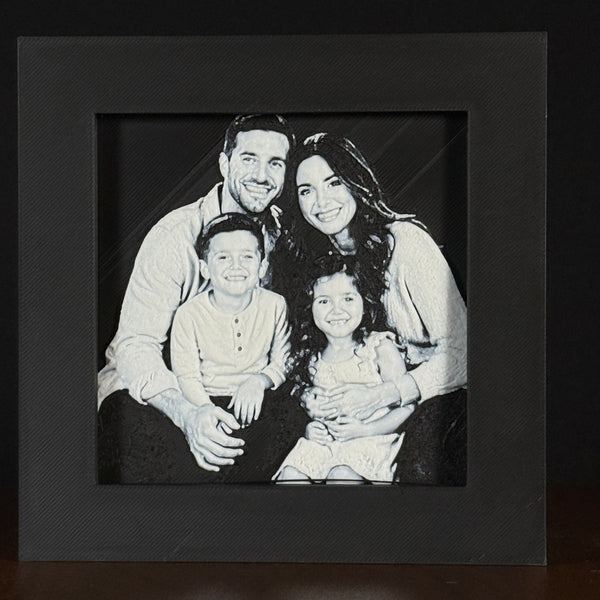
Shop The Look
Keep Reading
Memorial Art for Horses, Birds, Rabbits, Reptiles, and Other Companions
A companion does not need to be a dog or cat for the relationship to deserve a personal...
Pet Collar Memorial Display: How to Keep the Collar Safely at Home
The original collar should remain with the family. Photograph it, measure it, confirm the current display format, and...
Wedding Photo Gifts for Parents and Grandparents
The strongest parent or grandparent gift uses the wedding photograph that belongs to that relationship—not simply the couple's...